There is a frustrating situation that happens with some patients dealing with pain: they know they need to move more, but moving is the very thing that hurts.
Someone with back pain may be told that strengthening and exercise could help, yet bending over to put on a pair of shoes is already difficult. A patient with knee pain may need to strengthen the muscles around the knee and hip, but walking across a parking lot is uncomfortable. With shoulder pain, even reaching into a cabinet can become something you think twice about.
So where do you start?
Sometimes the answer isn’t choosing between medical treatment and physical therapy. It is figuring out how the two can work together.
At Michigan Pain Management, we look at pain as more than a number on a pain scale. Where does it hurt? What makes it worse? Just as importantly, what has the pain stopped you from doing?
Those questions can help determine what needs to happen next.
Sometimes Pain Needs to Settle Down Before You Can Make Progress
Physical therapy can be an important part of recovery, but there is a practical issue that doesn’t get talked about enough.
You have to be able to participate in it.
If a patient’s pain is severe enough that he or she can barely tolerate movement, simply handing that person an exercise program may not accomplish much. The first priority may be getting the symptoms under better control.
Depending on the diagnosis, medical history and severity of the problem, pain management might involve medication, an injection, a nerve block, changes in activity or another procedure. Not every patient needs these treatments, and not every type of pain responds to the same approach.
The point isn’t to eliminate every sensation before someone starts moving again.
Often, it’s about making the pain manageable enough that rehabilitation becomes realistic.
Once that happens, physical therapy has a different job to do.
The Painful Area Isn’t Necessarily the Whole Problem
Let’s use knee pain as an example.
Your knee hurts, so naturally you assume the knee is the problem. And it certainly may be part of it. But during a physical therapy evaluation, the therapist may notice something happening somewhere else.
Maybe the muscles around your hip have become weak.
Maybe your ankle isn’t moving particularly well.
Perhaps you’ve changed the way you walk because you’ve been protecting the painful knee for the past three months.
Those things matter.
The same idea applies to the back. A person who sits at a computer for eight or nine hours a day presents a very different situation from someone who spends the workday carrying equipment, climbing ladders or repeatedly getting in and out of a truck.
Both may say, “My lower back hurts.”
What happens next shouldn’t automatically be the same.
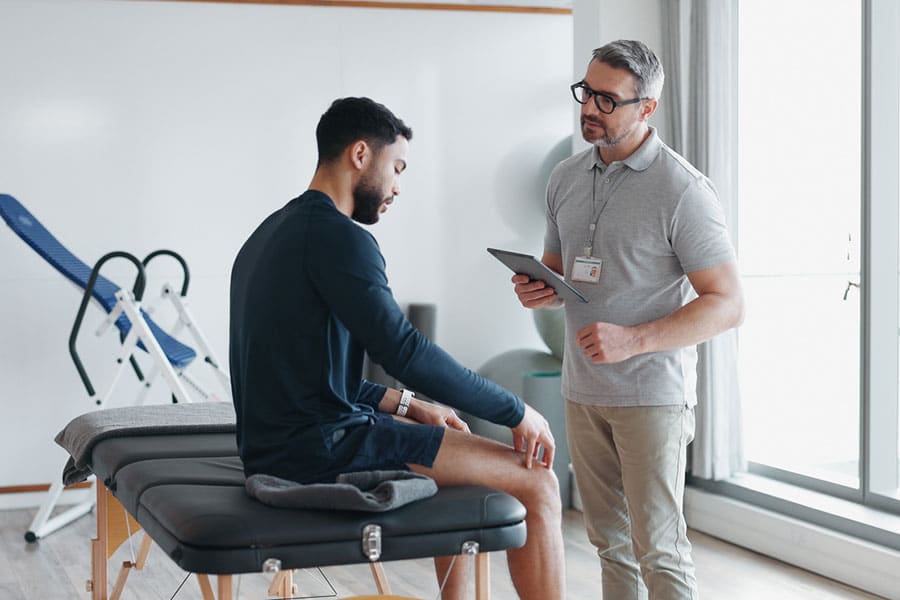
A physical therapist can look at strength, joint motion, flexibility, balance and the way a person performs everyday movements. Sometimes that means watching someone walk. Other times it may involve bending, squatting, reaching or recreating part of an activity that tends to cause trouble.
What the therapist finds helps shape the rehabilitation plan.
A Few Exercises Aren’t the Same Thing as Physical Therapy
People occasionally think of physical therapy as going to an appointment, learning three stretches and repeating them at home.
There can be quite a bit more to it.
Exercise is certainly important, but which exercises are chosen—and when they are introduced—matters. Someone early in recovery may need relatively simple movements. A few weeks later, those same exercises may no longer be challenging enough.
The program has to move forward with the patient.
Treatment may involve mobility work, progressive strengthening, balance exercises, manual techniques and changes to the way certain movements are performed. There is usually work to do outside the clinic as well.
And eventually the exercises should have some connection to real life.
If your goal is getting back onto the golf course, that’s different from preparing to lift 50-pound boxes at work. If what you really want is to walk through the grocery store without searching for somewhere to sit, that matters too.
“Getting better” means different things to different people.
Newer Physical Therapy Techniques Can Be Useful, But They Need a Reason
Modern physical therapy has more tools available than it did years ago.
That’s a good thing, but newer doesn’t automatically mean better.
The question should be whether a particular technique makes sense for the person being treated.
Blood Flow Restriction Training
Strengthening a muscle usually requires putting some resistance against it. That can become difficult when a painful joint or recovering body part doesn’t tolerate heavier loads very well.
Blood flow restriction training, or BFR, takes a different approach. A specialized cuff is used while the patient performs exercises with lighter resistance.
For an appropriately selected patient, this can provide another way to work on strength when heavier resistance isn’t currently practical.
BFR requires appropriate screening and supervision. It isn’t something every patient should receive simply because the equipment is available.
Dry Needling
There are also times when tight or sensitive areas of muscle appear to be contributing to pain and restricted movement.
Dry needling may be considered in some of these situations. A trained provider uses thin needles in selected muscular areas as part of the treatment plan.
But dry needling isn’t a complete rehabilitation program by itself.
A patient may feel better after a treatment and still need to work on the weakness, mobility problem or movement pattern that contributed to the problem in the first place.
Measuring Movement and Progress
Technology has also made it easier to measure certain aspects of rehabilitation.
Range of motion, balance and other physical changes can sometimes be tracked more objectively. Digital exercise programs and remote rehabilitation tools may also help some patients continue their program away from the clinic.
That can be particularly useful because progress isn’t always obvious from day to day.
You might not notice that you’re gradually walking farther. You may forget how difficult it was to reach overhead six weeks ago. Objective measurements give the therapist another way to determine whether the plan is actually working.
They also help answer an important question:
Do we keep going, or do we need to change something?
What Happens When Physical Therapy Isn’t Working?
This is another reason communication between medical providers and physical therapists can be valuable.
Suppose a patient has been participating in therapy but isn’t making the progress everyone expected.
That shouldn’t automatically be treated as a failure.
Maybe pain is still preventing the patient from doing enough during therapy. Maybe the original diagnosis needs another look. Perhaps another treatment should be considered. Or the rehabilitation program itself may need to change.
Information from physical therapy can be useful to the medical provider, just as information from the medical evaluation can help guide rehabilitation.
Pain care doesn’t have to happen in separate boxes.
Pain Relief Is Important. So Is Getting Your Life Back.
Ask someone who has dealt with pain for six months what they want from treatment and the answer usually isn’t a medical term.
They want to sleep.
They want to play with their kids.
They want to work without spending the rest of the evening recovering from it.
They want to exercise again, mow the lawn, walk the dog or make it through a round of golf.
Those are useful measures of progress.
A person can still have some discomfort and be doing considerably better than they were a month earlier. Maybe they can walk for 25 minutes instead of five. Perhaps they’re sleeping through the night again. Maybe they can finally lift their arm high enough to put something on the top shelf.
Those aren’t small details. They’re the reason treatment is being done in the first place.
Recovery Usually Changes Along the Way
A good treatment plan shouldn’t look exactly the same on day one and week eight.
Early on, the priority may be figuring out what’s causing the pain and making everyday movement more tolerable.
Then the emphasis can shift.
More movement. More strength. More endurance. More confidence using the painful area again.
Eventually, the focus may be returning to work, exercise, sports or whatever the patient couldn’t comfortably do before.
There can be setbacks along the way. A difficult day doesn’t necessarily erase several weeks of progress. Likewise, feeling better for a few days doesn’t always mean the underlying problem has been addressed.
This is where reassessment becomes important.
Why Combine Pain Management and Physical Therapy?
Because pain and function aren’t exactly the same problem.
Medical treatment may help control pain or address a specific source of symptoms. Physical therapy can concentrate on what happens when you stand up, walk, bend, lift, reach and exercise.
For some patients, one approach may be all that’s necessary. Others may benefit from both at different stages of recovery.
The important part is not forcing every patient through the same treatment sequence.
If pain is keeping you from working, exercising, sleeping comfortably or doing normal activities, the first step is figuring out why.
At Michigan Pain Management, we can evaluate your symptoms, review what you’ve already tried and discuss appropriate treatment options. When physical therapy should be part of the plan, it can be coordinated around the same basic goal: not simply helping you hurt less, but helping you get back to doing more.